President Donald Trump was meeting with reporters at the White House on Thursday, April 30, 2026, answering questions in the aftermath of the third alleged assassination attempt on his life, when a reporter asked the question that was on every security analyst’s mind: “Is there talk about wearing a bulletproof vest going forward?” The President
President Donald Trump was meeting with reporters at the White House on Thursday, April 30, 2026, answering questions in the aftermath of the third alleged assassination attempt on his life, when a reporter asked the question that was on every security analyst’s mind: “Is there talk about wearing a bulletproof vest going forward?”
The President paused, looked at the reporter, and delivered a punchline that brought down the house. “I don’t know if I can handle looking 20 pounds heavier,” Trump said, drawing immediate and uncontrollable laughter from everyone in the room, including the reporter who asked the question.
It was the kind of line that no speechwriter could have manufactured, because it required the particular blend of self-deprecation, comic timing, and total fearlessness that defines Trump’s unscripted moments at their best. The room, filled with reporters who spend most of their professional lives trying to find the worst possible framing for anything the President says, broke entirely.
Nobody could keep a straight face. The clip went viral within minutes and had accumulated millions of views before the afternoon was out.
Trump did not stop at the first punchline. He followed it up with an addendum that made the room erupt all over again. “If you want to gain 20 to 25 pounds, get a vest and live,” he added.
The line had everything: the self-aware acknowledgment that he is not a small man, the dark humor about survival, and the timing of a natural comedian who knows when the crowd is with him and how far to push it. It was, by any honest measure, one of the funniest things said at the White House in recent memory.
The context in which the line was delivered makes it even more remarkable. Trump was not joking about a hypothetical threat. He has now survived three separate alleged assassination attempts since July 2024.
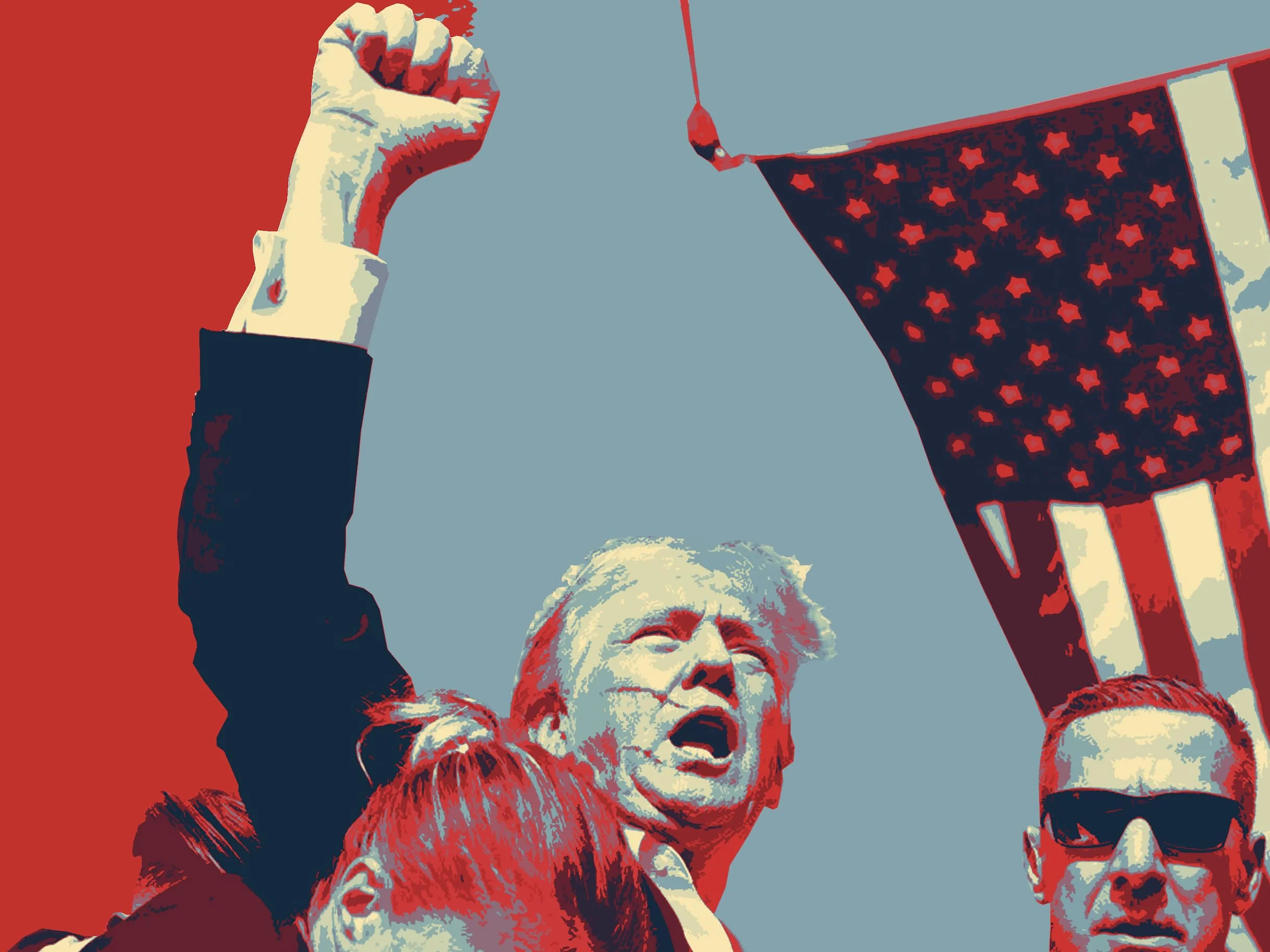
He took a bullet to the ear in Pennsylvania. A gunman was apprehended near his golf course in Florida. And just five days before this press conference, a man with two firearms, three knives, and a prewritten manifesto had checked into the same hotel as Trump during the White House Correspondents’ Dinner and attempted to push through a security checkpoint. A Secret Service agent took a bullet in the chest and survived only because of his ballistic vest.
Against that backdrop, most politicians would be somber, guarded, and scripted. Trump showed up to the press conference and made the room laugh about bulletproof vests.
That is not recklessness. It is something rarer: a man who has genuinely processed the reality of his situation and decided that fear is not going to be the operating principle of his presidency.
He made that explicit when a reporter followed up by asking how nervous he is about another assassination attempt happening again. Trump’s answer was four words: “I don’t think about it.” He then added the explanation that made the answer complete: “If I did, I wouldn’t be effective.” That is not bravado for the cameras. That is the statement of a man who understands that a president paralyzed by personal fear cannot lead a country, and who has made the internal decision not to be paralyzed.
The physical specimens remark added another layer to the moment. Trump gestured toward some of the Secret Service agents standing behind him during the briefing and described them as “physical specimens,” suggesting with a grin that he might tell them to move away so he would look better by comparison. The self-deprecation was total and entirely genuine. He was not pretending to be something he is not. He was making fun of himself with the ease of someone who is completely comfortable in his own skin.
RedState contributor Nick Arama captured the response of many conservative commentators when he wrote that Trump may just be the funniest person to ever occupy the White House. It is not an absurd claim. Presidential humor is usually scripted, focus-grouped, and delivered with the wooden timing of someone who has been told they need to seem more relatable. Trump’s humor is none of those things. It lands because it is real, it is spontaneous, and it is almost always at his own expense rather than at someone else’s.
Conservative commentator Ian Miller posted on X that the vest quip was funnier than anything Jimmy Kimmel or Stephen Colbert has said in decades. That is a pointed observation but not an entirely unfair one. The late-night hosts have access to writers’ rooms, production budgets, and rehearsed delivery. Trump had a press conference, a question about getting shot, and a brain that works faster than most. The comparison is not flattering to the comedy professionals.
The bulletproof vest question arose partly because of speculation that had circulated online following the CBS News “60 Minutes” interview that aired on Sunday, the day after the Washington Hilton shooting. During the interview, multiple viewers noticed what appeared to be a significant bulge under Trump’s suit jacket. Social media immediately split into factions, with one group claiming it was evidence of a diaper and another, more sensible group, concluding it was almost certainly a bulletproof vest worn under the suit in the aftermath of an assassination attempt at an event he had attended five days earlier. One commenter on X noted with some logic that it is the bottom part of a bulletproof vest, that presidents wear them constantly now after multiple assassination attempts regardless of party, and that the suit bunches up exactly like that in a sitting position, which is entirely normal at his height of 6 feet 3 inches.
The question of whether Trump should be wearing a bulletproof vest more visibly or consistently is a legitimate security discussion. The Secret Service has presumably had that discussion internally with far more information than the general public has about what protective measures are already in place. The three assassination attempts in less than two years have clearly altered the security calculus around protecting this particular president, and whatever protocols are in place are known to the people responsible for his safety, not to cable news panels.
What the press conference moment illustrated is something that goes beyond the comedy. Trump’s ability to deflect serious personal danger with humor is not just personality. It is a leadership quality. Leaders who project calm under pressure do not do so by pretending the pressure does not exist. They acknowledge it and then refuse to be defined by it. Trump acknowledged on Thursday that getting a vest means looking 20 to 25 pounds heavier, and he presented that as his primary objection. The press corps laughed. The country watched the clip. And the message underneath the joke was unmistakable: this man is not afraid.
His comment that he would not be effective if he spent his time thinking about assassination attempts is arguably the most important thing he said at Thursday’s press conference, even though it received far less attention than the 20-pounds-heavier line. A president who is consumed by fear of personal harm will make decisions driven by that fear. He will avoid public events, curtail press access, retreat behind a security perimeter, and govern from a posture of self-protection rather than national leadership. Trump, whether by temperament or by deliberate choice, has rejected that posture entirely. He said on Sunday that he wanted to go back and see what was happening at the Washington Hilton after the shooting. His Secret Service agents disagreed. The disagreement was not close.
The reaction from the political right to the vest quip was uniformly celebratory. Conservative social media lit up with the clip immediately. The Trump War Room account posted the moment on X within minutes. Republican operatives and commentators shared it widely, not just as comedy but as a character statement. This, they argued, is what a president looks like when he is not performing strength but actually possessing it.
The left’s reaction was more complicated. Several mainstream media outlets noted the quip in their coverage of the Thursday press conference but framed it primarily in the context of the 60 Minutes speculation, using the vest question as a hook for the diaper theory that had circulated online. That framing reflects the persistent difficulty mainstream media outlets have had in processing Trump humor on its own terms rather than as a vehicle for adversarial narrative.
There is also a substantive point buried in the humor. Trump added after the vest line that he is very well protected by wonderful people. That is a sincere acknowledgment of the Secret Service, whose professionalism under extraordinary circumstances has been remarkable. Three attempted assassinations of a single president in under two years is historically without precedent in the modern security era. The agents who have stood between Trump and serious harm at Butler, West Palm Beach, and now the Washington Hilton have performed with courage that deserves more public recognition than it typically receives.
The Thursday press conference came just five days after Cole Allen’s alleged attempt at the Washington Hilton, in the middle of a week dominated by the 60 Minutes interview, the manifesto controversy, the Obama statement about motives, and the ongoing investigation into the attack. It was not a press conference designed for comedy. The questions were serious. The security context was deadly. And Trump walked in and turned the gravest personal question of his presidency into the most-watched clip of the week.
That is who this president is. Whatever one thinks of his policies, his politics, his personality, or his history, the man who stands at a podium five days after a third attempt on his life and makes the room laugh about not wanting to look fat in a bulletproof vest is not a man who is governed by fear. He is a man who has decided, at some fundamental level, that if the country needs him to be effective, he cannot afford to think about it.