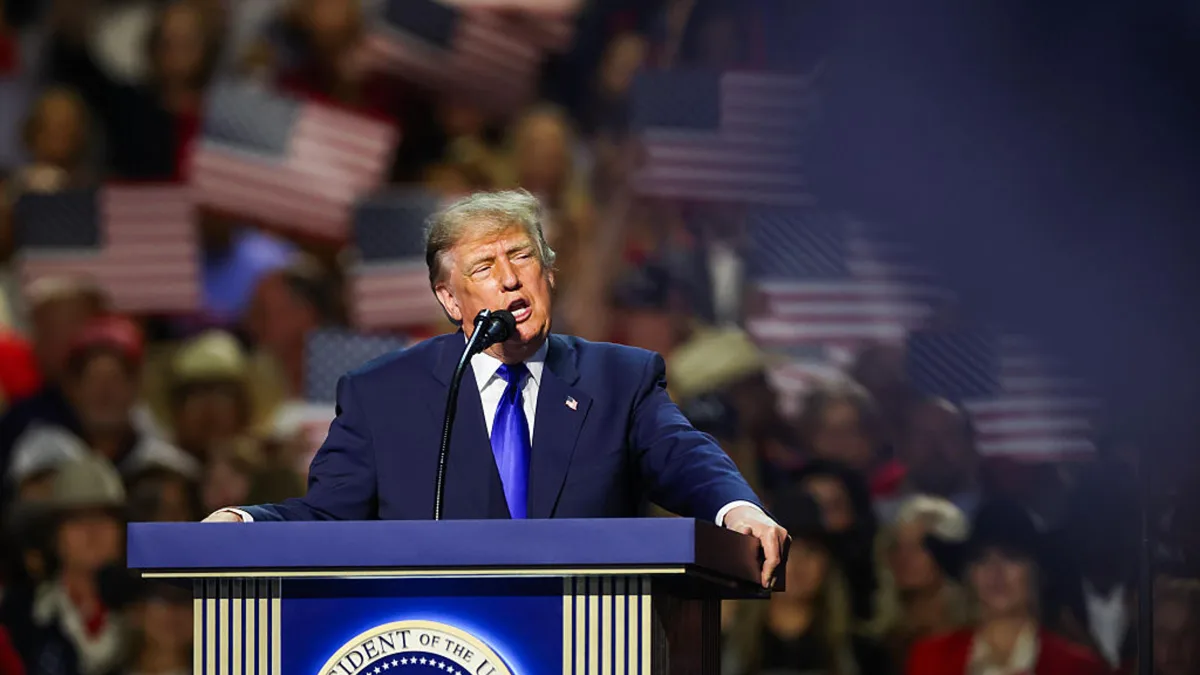
President Trump announced Sunday that the Triumphal Arch planned for Memorial Circle will be built as a working military complex as well as a monument. He said it will be able to store and rapidly deploy drones, snipers and ammunition, and that the change came at the strong request of the U.S. military and for

President Trump announced Sunday that the Triumphal Arch planned for Memorial Circle will be built as a working military complex as well as a monument. He said it will be able to store and rapidly deploy drones, snipers and ammunition, and that the change came at the strong request of the U.S. military and for national security.
In his Truth Social post, the president said the structure would hold large numbers of drones and sniper teams on both the roof and the plaza, along with a large store of sniper ammunition. He added that there would be “no facility like this anywhere in the World.”
Trump has not yet named the officials or service branches behind the request, and no formal military document has been released. Reporters and the public will reasonably want those details, and the administration should provide them.
The arch would sit on an empty traffic island in Memorial Circle, between the Lincoln Memorial and Arlington National Cemetery, near Ronald Reagan Washington National Airport. The main structure is about 160 feet tall and reaches 250 feet with a gold-winged figure and two eagles on top.
The announcement follows a string of recent wins for the project. On Friday the FAA concluded the arch would have no substantial adverse effect on flights, after an eight-page report and a preliminary approval in June.
The FAA is requiring an eternal flame atop the structure and three floodlight projectors so pilots can see it. Its finding becomes final in late October unless a petition is filed by October 18. That answers a concern raised by Democrats about the tight airspace near Reagan National.
The location is close to an airport that was the site of the January 2025 midair collision that killed 67 people. Sen. Tammy Duckworth had urged the FAA to reject what she called a vanity arch. The agency’s review found otherwise.
Interior Secretary Doug Burgum said earlier this month that preliminary construction would begin within two weeks. A federal judge then ordered the administration to give 48 hours’ notice before any activity on the site, except work to identify underground cultural artifacts.
The National Capital Planning Commission gave preliminary approval in July but has not yet issued its final go-ahead. Several regulatory steps remain, and the military design elements will presumably have to work through them too.
The security reasoning is easy to follow. Fox News reports the country is fighting a war with Iran, and a NORAD F-16 intercepted an aircraft that violated restricted airspace over Camp David while the president was there. A high vantage point in the capital, equipped with drone capability, fits that environment.
The 2024 assassination attempt in Butler, Pennsylvania, is a reminder of what elevated positions and drones can mean for protective operations. The shooter flew a drone for roughly 11 minutes to scout his position, and local police counter-snipers inside a nearby building had no one on the roof because of a staffing shortage. Fixed, well-manned overwatch is not a theoretical concern.
The arch also follows the pattern of the White House ballroom. The administration has said that project includes a drone-launching pad and an underground military complex, and Trump has called it necessary for national security. The president appears to be building security capability into the capital’s showpiece structures.
In his post, Trump said Washington is the only one of the world’s 59 top cities and capitals without a triumphal arch. He said it will now have one. The Washington Examiner has argued that the arch will be a triumph for the president, and it noted that the Capitol dome and the Washington Monument would still stand taller.
White House spokesman David Ingle previously said the arch will be one of the most iconic landmarks in the world. Communications director Steven Cheung answered critics who called it too big by saying the experts are used to living with things being small.
Opposition remains organized. Three Vietnam veterans and an architectural historian, represented by the progressive group Public Citizen, sued to stop construction. They say it would obstruct the view between Arlington House and the Lincoln Memorial and that the president never sought proper approval.
Fox News also reported Saturday that a lawyer in the case argues the arch disrupts sightlines cherished by veterans who plan to be buried at Arlington. Those are serious sentiments, and the courts will weigh them.
Rep. Don Beyer, a Virginia Democrat whose district includes Arlington, called the arch plainly illegal and said it was not ready to be built. The administration and its allies disagree, and the litigation will settle the question.
The Washington Examiner reports that the National Park Service documented adverse effects on historic properties and offered a plan to mitigate them. Critics say this proves the project is damaging. Supporters counter that federal review is doing its job, and that mitigation is how large projects normally go forward.
The new military role raises fair questions about security, public access, approvals and the storage of weapons beside a sensitive ceremonial site. The administration should say which agencies will operate the facility, how the ammunition will be secured, and how visitors will still be able to enjoy it.
The arch also has a clear symbolic purpose. It is meant to mark America’s 250th anniversary, and supporters see it as a confident answer to a capital that has long celebrated its history with columns and memorials but not a gateway of this kind. Nations that believe in themselves build monuments.
The Washington Examiner reports that officials hope to finish the arch by 2028. The paper has also reported that construction could take up to three years, so the timeline is aggressive.
The next milestones are the FAA’s October 18 petition deadline, final sign-off from the planning commission, and the court fight over the veterans’ suit and the judge’s notice order. The design details for the drone and sniper facilities have not been released, and they will shape the debate from here.
Trump has promised a monument unlike any other, and a military complex is now part of the plan. Whether the security case holds up will depend on the details the White House puts on the record.