For years, Americans who questioned whether COVID-19 may have escaped from the Wuhan Institute of Virology were ridiculed, censored, and branded as dangerous conspiracy theorists. Social media companies suppressed discussion, established journalists dismissed the possibility, and government officials repeatedly assured the public that the science pointed overwhelmingly toward a natural orig
Newly released documents, however, suggest that behind closed doors, Fauci and other senior health officials were far less confident than they appeared before the American people.
Sen. Rand Paul, R-Ky., who has spent years investigating the origins of the pandemic and the federal government’s involvement in coronavirus research, released more than 1,000 pages of Fauci’s diary entries and internal records. The documents raise serious questions about whether public-health officials treated the lab-leak hypothesis as a legitimate scientific possibility—or as a political and institutional threat that needed to be contained.
According to the records, Fauci was alerted to concerns about the virus’s origins as early as January 31, 2020, only weeks after the outbreak emerged. He recorded that some scientists believed the virus may have contained unusual or potentially engineered features and quickly organized a private conference call with prominent virologists and evolutionary biologists.
Paul’s office said roughly half of the scientists participating in that early discussion initially believed the virus appeared “constructed.”
That internal alarm stands in sharp contrast to the confidence projected publicly in the months and years that followed. Rather than openly acknowledging that respected scientists were seriously considering a laboratory origin, government officials repeatedly presented natural animal transmission as the only respectable explanation.
Americans were not told that experts had privately raised concerns about laboratory manipulation. They were told that questioning the official narrative placed them outside the boundaries of legitimate debate.
This was not merely a disagreement over scientific evidence. It became an organized campaign to control what the public was allowed to discuss.
Previously released emails showed Fauci and then-National Institutes of Health Director Francis Collins discussing how to counter scientists who raised questions about a possible lab origin. Rather than welcoming open scrutiny into a pandemic that killed millions and disrupted the entire world, officials appeared focused on discrediting skeptics and labeling their concerns as conspiracy theories.
The Heritage Foundation has argued that NIH leadership helped orchestrate an effort during the opening months of the pandemic to undermine the lab-leak hypothesis while promoting the natural-origin explanation. A House investigation led by Republican Rep. Brad Wenstrup of Ohio gathered more than 8,000 documents and nearly 25 hours of testimony examining how the government’s response developed.
That investigation also focused heavily on federal funding that flowed through EcoHealth Alliance to research conducted with the Wuhan Institute of Virology.
EcoHealth Alliance participated in coronavirus research involving the Wuhan laboratory, yet investigators found serious failures in oversight and grant compliance. The organization reportedly failed to submit required reports on time and did not fully satisfy federal monitoring requirements. Meanwhile, concerns about biosafety practices at the Wuhan facility only intensified as more information became available.
These facts made the possibility of an accidental laboratory release worthy of immediate and transparent investigation.
Instead, the public was frequently encouraged to treat any discussion of the theory as reckless or anti-scientific.
Collins reportedly contributed to that dismissal by grouping the accidental lab-leak hypothesis together with far more sensational claims that the virus had been deliberately created as a bioweapon. That conflation was politically convenient. By blurring the distinction between an accidental research-related incident and intentional biological warfare, officials could dismiss the entire subject without addressing the most plausible concerns.
The laboratory-origin hypothesis never required believing that China intentionally released a weapon. It required only acknowledging that dangerous research was being conducted in Wuhan, that safety concerns existed and that human error remains possible in any laboratory.
Yet Americans who made that argument were often treated as extremists.
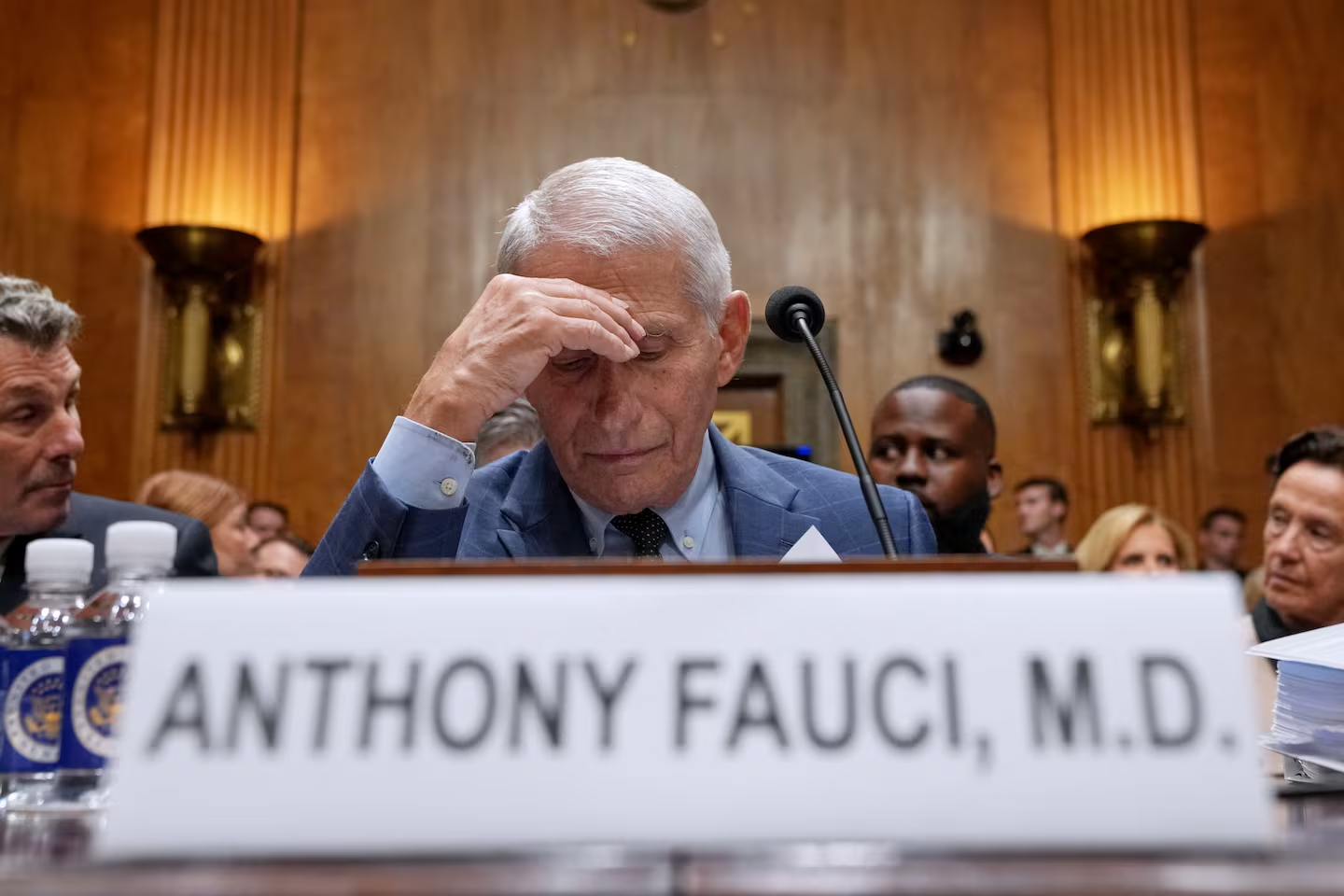
The latest documents have intensified demands for accountability. Fauci was called before the Senate Homeland Security and Governmental Affairs Committee in late July, with Paul presiding over the hearing. Paul had subpoenaed Fauci to answer questions under oath about the pandemic’s origins, federal research funding and the government’s public statements.
Fauci declined to answer the committee’s questions and invoked his Fifth Amendment right against self-incrimination on the advice of his attorneys.
Invoking the Fifth Amendment is a constitutional right and is not, by itself, proof of guilt. Nevertheless, the spectacle of one of the most influential government officials of the pandemic refusing to answer questions before Congress will inevitably deepen public suspicion.
For years, Fauci insisted that he welcomed scrutiny and followed the evidence. When presented with an opportunity to explain the newly released records under oath, he chose silence.
Paul opened the hearing by accusing Fauci of withholding the full truth from the American people and misleading Congress. He described the level of alleged dishonesty revealed in the records as “really astounding.”
Republican senators argued that while Fauci received media praise, book deals, awards and celebrity treatment, ordinary Americans endured business closures, school shutdowns, employment mandates and rapidly changing government directives.
Millions lost jobs or businesses. Children lost critical years of education. Families were separated from dying relatives. Citizens who questioned the wisdom of these policies were frequently accused of opposing science itself.
The demand for accountability is therefore not personal revenge against Fauci. It is a demand to understand how unelected officials acquired enormous power, how they used that power and whether they told the public the truth.
One November 2021 diary entry shows Fauci anticipating another confrontation with Paul, writing that the senator continued to make false claims about gain-of-function research. The entry demonstrates how deeply personal the dispute had become.
But the origins of COVID-19 and the use of federal research money are not personal matters between two political adversaries. They are questions of national security, scientific ethics and public trust.
Paul has suggested that the Department of Justice under the Trump administration could examine the records, although he has not publicly identified a single diary entry that conclusively establishes criminal wrongdoing.
The situation is further complicated by the preemptive pardon Fauci received from President Joe Biden during the closing hours of his administration. Critics argue that the extraordinary pardon was intended to insulate Fauci from future prosecution and prevent a full accounting of his pandemic-era conduct.
Supporters contend that the pardon protected a public servant from politically motivated retaliation.
Either way, the decision sent a troubling message. Pardoning someone before charges have been filed naturally invites Americans to ask what conduct the outgoing administration feared might be prosecuted.
Fauci has maintained that he never categorically ruled out an accidental laboratory release. He argues that he was merely opposing unsupported claims and that the strongest available scientific evidence favored animal-to-human transmission.
That defense does not fully address the central issue.
The problem is not simply whether Fauci occasionally admitted that a laboratory origin was technically possible. The problem is that officials privately discussed significant concerns while publicly encouraging the impression that the question had already been resolved.
There is an enormous difference between saying the evidence currently favors one theory and telling the public that the competing theory is misinformation.
That distinction became even more important when Big Tech companies began censoring users, restricting articles and suppressing posts that questioned the natural-origin narrative. Facebook and other platforms treated discussion of a potential laboratory escape as misinformation, relying partly on the authority of the same public-health establishment that was privately debating the issue.
Journalists who explored the theory were dismissed as fringe. Scientists who privately had doubts faced powerful professional incentives to remain silent. Ordinary citizens were punished online for asking questions that government agencies would later admit deserved investigation.
The consequences went far beyond one scientific debate.
The censorship taught millions of Americans that government officials could define a disputed claim as false, pressure technology companies to suppress it and then quietly revise their position years later without accepting responsibility.
That is not how scientific inquiry is supposed to work, and it is not how a free society should operate.
Science advances through skepticism, transparency and the testing of competing explanations. It does not advance by silencing dissent, protecting powerful institutions or declaring politically inconvenient questions off-limits.
Over time, several government agencies shifted their assessments. The Department of Energy and the CIA reportedly came to favor a laboratory-related origin, although with varying levels of confidence. Other agencies have continued to favor natural transmission or remain undecided.
The continuing disagreement demonstrates exactly why the government’s early certainty was so irresponsible.
The origin of COVID-19 remains unresolved. Yet the possibility that the pandemic began through a research-related incident is no longer treated as an absurd conspiracy. It is now considered a serious explanation by parts of the United States intelligence community.
The Trump administration has adopted an even more definitive position. After President Donald Trump returned to office in January 2025, the federal Covid.gov website was redirected to a page presenting the laboratory-leak explanation as the administration’s official conclusion.
Health and Human Services Secretary Robert F. Kennedy Jr., a longtime Fauci critic, reportedly helped obtain Fauci’s diary records and provide them to Paul. Kennedy has consistently argued that the public-health establishment misled Americans not only about the virus’s origins, but also about lockdowns, masking, vaccine policies and the suppression of dissent.
Critics of Paul, Kennedy and the Republican-led investigations argue that the release of the records was politically timed and that the investigations have been shaped by partisan motives. They also correctly note that the diary does not contain a simple confession showing Fauci knew with certainty that the virus escaped from a laboratory.
But such a confession is not necessary to establish that the public deserved greater honesty.
The documents suggest that Fauci knew serious scientists were considering a laboratory origin from the earliest days of the outbreak. They show that senior officials privately discussed concerns that were later minimized or dismissed in public. They also reveal a bureaucracy focused on managing the narrative surrounding the laboratory theory.
The central scandal may not be that Fauci secretly knew exactly where COVID-19 originated.
It may be that he did not know—but spoke with a level of certainty that discouraged investigation, empowered censorship and misled millions of Americans into believing the matter had been scientifically settled.
Public-health officials could have told the truth from the beginning: The evidence was incomplete, several possibilities were being investigated and no theory should be ruled out until the facts were known.
Instead, powerful institutions chose certainty over humility, censorship over debate and reputation management over transparency.
Americans who questioned them were called conspiracy theorists. Years later, many of those questions remain unanswered, while the officials who demanded the public’s unquestioning trust continue to resist a complete accounting of their decisions.
The public deserves more than carefully worded denials and partisan excuses. It deserves every relevant record, every internal communication and sworn testimony from every official involved.
 For years, Americans who questioned whether COVID-19 may have escaped from the Wuhan Institute of Virology were ridiculed, censored, and branded as dangerous conspiracy theorists. Social media companies suppressed discussion, established journalists dismissed the possibility, and government officials repeatedly assured the public that the science pointed overwhelmingly toward a natural origin.