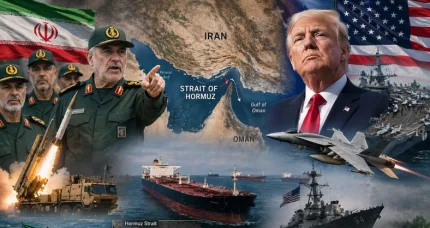
U.S. Navy guided-missile destroyers transited the Strait of Hormuz on Saturday, April 11, 2026, marking the first time American warships crossed the waterway since the conflict with Iran began. The operation is the initial step in clearing sea mines laid by Iran’s Islamic Revolutionary Guard Corps (IRGC) to restore safe passage for commercial shipping. The
U.S. Navy guided-missile destroyers transited the Strait of Hormuz on Saturday, April 11, 2026, marking the first time American warships crossed the waterway since the conflict with Iran began. The operation is the initial step in clearing sea mines laid by Iran’s Islamic Revolutionary Guard Corps (IRGC) to restore safe passage for commercial shipping.
The two Arleigh Burke-class destroyers involved were the USS Frank E. Petersen Jr. (DDG-121) and the USS Michael Murphy (DDG-112). They crossed from east to west into the Arabian Gulf (Persian Gulf) and later returned through the strait to the Arabian Sea. U.S. Central Command (CENTCOM) confirmed the ships operated in the Gulf as part of a broader mission to ensure the strait is fully clear of mines.
The operation was not coordinated with Iran. Iran had previously threatened to attack any unauthorized military vessels entering the strait. No incidents were reported during the transit, despite Iranian state media claims and threats.
12,200+
patriots joined
Keep reading — stay on the brief
Daily MAGA briefing in your inbox. Free, unsubscribe anytime.
President Donald J. Trump announced the start of the clearing effort on Truth Social. He stated that the U.S. military had begun the process and claimed all 28 of Iran’s mine-laying boats had been sunk earlier in the conflict. He described the action as necessary to reopen the critical chokepoint.
The Strait of Hormuz carries roughly 20 percent of the world’s daily oil supply and about one-quarter of all seaborne traded oil. Iran’s decision to close or restrict the strait during the conflict caused major disruptions, higher oil prices, and supply concerns for global markets. Reopening it safely is a key baseline goal for American interests and the fragile two-week ceasefire.
CENTCOM Commander Admiral Brad Cooper stated that the destroyers were setting conditions for full mine clearance. Additional U.S. forces, including underwater drones and dedicated minesweepers, are expected to join the effort in the coming days. The goal is to establish a new safe passage and share it with the maritime industry to encourage the free flow of commerce.
This move follows Trump’s earlier maximalist warnings to Iran. His Easter message demanded the strait be reopened or Iran would face severe consequences, including strikes on infrastructure. The ceasefire was reached after Iran agreed to pause hostilities and allow safe passage, but the U.S. is not relying solely on Iranian promises. American forces are verifying and securing the waterway directly.
The operation demonstrates continued American resolve. Weak policies in prior years allowed Iran to grow bolder, leading to attacks on shipping and the recent closure. Under the current administration, the response has been direct: project strength, enforce freedom of navigation, and protect global energy supplies that affect American families through gas prices and economic stability.
Iran denied aspects of the U.S. transit and called it a potential ceasefire violation in some reports. However, the U.S. proceeded without seeking permission, consistent with long-standing policy that the strait is an international waterway.
The timing coincides with ongoing ceasefire talks in Islamabad, Pakistan. The two-week pause remains fragile, and the mine-clearing effort ensures that commercial shipping can resume without depending entirely on Iranian goodwill or “technical limitations” that Tehran tried to impose.
Conservatives have long argued that allowing any single hostile regime to control or threaten a vital global chokepoint like the Strait of Hormuz is unacceptable. The U.S. Navy’s actions reinforce the principle that America will not tolerate disruptions that harm U.S. economic interests or those of allies.
No U.S. ships were harmed during the transit. The operation is described as a freedom-of-navigation mission combined with practical mine countermeasures. Full clearance may take days or weeks depending on the number and location of mines Iran deployed.
This development builds on the earlier ceasefire secured after Trump’s strong warnings. It shows the administration is following through on baseline goals: safe, unrestricted access to the strait without granting Iran veto power or control.