President Donald J. Trump’s decision to impose a naval blockade on Iranian ports in the Strait of Hormuz is delivering serious economic pressure on the Iranian regime. The blockade began on April 14, 2026, after weekend talks in Islamabad collapsed. Iran refused to meet any of the six key U.S. red lines on nuclear activities,
President Donald J. Trump’s decision to impose a naval blockade on Iranian ports in the Strait of Hormuz is delivering serious economic pressure on the Iranian regime.
The blockade began on April 14, 2026, after weekend talks in Islamabad collapsed. Iran refused to meet any of the six key U.S. red lines on nuclear activities, terror funding, and full reopening of the strait.
Analysts estimate the blockade is costing Iran roughly $400 million to $435 million per day in lost export revenue, primarily from oil and petrochemicals. Some reports place the direct oil revenue loss closer to $150 million daily, but broader economic damage—including tolls, petrochemicals, and secondary effects—pushes the total higher.
12,200+
patriots joined
Keep reading — stay on the brief
Daily MAGA briefing in your inbox. Free, unsubscribe anytime.
Before the recent conflict, Iran exported about 1.5 to 1.8 million barrels of oil per day. During the war, it maintained near pre-war levels in some periods while charging high prices and tolls, earning an estimated $139 million per day from its main crude blend in March 2026.
The Strait of Hormuz normally carries about 20 million barrels of oil per day, representing roughly 20 percent of global daily oil consumption and 25 percent of seaborne traded oil. Iran’s earlier closure and toll demands disrupted that flow and created a wartime windfall for Tehran.
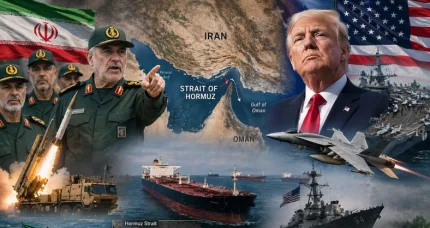
The U.S. Navy has already begun enforcing the blockade with destroyers and additional assets. The goal is to prevent Iran from loading and exporting oil from terminals like Kharg Island while restoring safe passage for international shipping.
This move follows President Trump’s maximalist strategy. He warned Iran to reopen the strait or face consequences. When talks failed, the blockade became the next step to enforce American baseline goals without starting a new ground war.
Iran has relied heavily on oil revenue to fund its government, military, and proxy groups. Oil exports accounted for about 13 percent of its GDP in recent years. Cutting off that revenue starves the regime of hard currency needed for operations.
China buys the majority of Iran’s oil, often 45 to 50 percent of its exports. The blockade pressures Beijing as well, since it disrupts a key discounted supply source. Trump has warned China against providing arms to Iran and offered alternative oil sources.
The blockade is not aimed at destroying Iranian oil infrastructure. It targets revenue flows while preserving long-term assets. This approach puts economic pain on the ayatollahs without broader regional destruction.
Conservatives have long argued that maximum pressure works better than weak deals like the 2015 JCPOA. Past administrations gave Iran cash and sanctions relief while the regime advanced its nuclear program and funded terrorism. Trump’s first term showed sanctions could contain Iran without new wars.
The current blockade builds on that record. It follows the two-week ceasefire that Iran has already failed to honor fully. U.S. Navy operations in the strait demonstrate resolve to protect global energy supplies that affect American gas prices and jobs.
Estimates of daily losses vary slightly by source. One analysis put total economic damage at $435 million per day, including $276 million from crude and petrochemical exports at wartime prices around $87 per barrel. Another focused on direct oil revenue loss at $150 million daily.
Even at the lower end, the impact is significant. A sustained blockade could cost Iran billions per month and accelerate internal economic problems including currency devaluation and inflation.
Iran has threatened retaliation and called the blockade “piracy.” Yet the U.S. has proceeded without seeking permission, consistent with the principle that the Strait of Hormuz is an international waterway, not Iranian property.
The operation involves guided-missile destroyers and mine-clearing efforts. Earlier transits by USS Frank E. Petersen Jr. and USS Michael Murphy tested the waters. Additional forces are now enforcing the port blockade.
This pressure comes after Iran refused to end uranium enrichment, dismantle facilities, or stop supporting terrorist proxies. The six red lines were reasonable security requirements, not extreme demands.
Americans benefit when critical shipping lanes remain open and free from hostile control. Disruptions in the strait raise global oil prices and hit family budgets at the pump. The blockade aims to restore normal commerce on American terms.
The Trump administration has already shown results in other areas. ICE has arrested over 453,000 criminal illegal aliens since taking office. Border encounters have dropped sharply. The same focus on strength and accountability now applies to the Middle East.
Weakness under previous administrations invited Iranian aggression, including attacks on shipping and the recent strait closure. Maximum pressure forces choices and protects U.S. interests.
The blockade is a calculated gamble that the U.S. economy can withstand short-term costs better than Iran’s sanctioned and war-damaged economy. Iran’s regime depends on oil revenue to survive. Cutting it off increases internal pressure on the mullahs.
Talks could resume, but only if Iran shows willingness to meet baseline goals. Trump has made clear he prefers deals, but only deals that put America and its allies first.
The Navy’s professional execution of the mission reflects readiness and capability. No U.S. ships have been harmed, and operations continue to secure safe passage.
This development reinforces America First principles. The United States will not allow a hostile regime or its backers to threaten vital global chokepoints that affect energy prices and economic stability at home.
As the blockade takes effect, the daily cost to Iran underscores the effectiveness of decisive action. Hundreds of millions lost each day cannot be sustained indefinitely by a regime already under sanctions and internal strain.
President Trump’s approach has consistently delivered results through strength rather than endless concessions. The Strait of Hormuz situation is the latest example of that strategy in action.