Ordinary beachgoers in southern Spain did something European authorities have failed to do for years: they physically stopped illegal migrants from simply walking off a boat and disappearing into the crowd. The incident unfolded on a packed stretch of sand at Sotillo Beach in Castell de Ferro, a tourist town in Granada province, when a

Ordinary beachgoers in southern Spain did something European authorities have failed to do for years: they physically stopped illegal migrants from simply walking off a boat and disappearing into the crowd. The incident unfolded on a packed stretch of sand at Sotillo Beach in Castell de Ferro, a tourist town in Granada province, when a black motorboat sped toward shore in broad daylight. What happened next is now circulating across the world, and it says everything about how ordinary Europeans feel about their governments’ handling of the migrant crisis.
According to local authorities, thirteen men believed to be from North Africa jumped from the vessel just offshore and swam toward the crowded beach in the middle of a Sunday afternoon. Lifeguards spotted the boat first and raised the alarm, giving sunbathers only moments to react before the men came ashore. Rather than scatter or look away, several tourists and locals moved toward the migrants instead of away from them.
12,200+
patriots joined
Keep reading — stay on the brief
Daily MAGA briefing in your inbox. Free, unsubscribe anytime.
Video captured on phones by stunned witnesses shows the men diving into the water fully clothed and racing toward the sand as police tried to close in. Some of the migrants reportedly wore hoods, apparently in an attempt to conceal their identities as they ran through the crowd. In the chaos, at least one man attempted to blend in with beachgoers before he was caught.
One clip that has drawn particular attention shows a bare-chested beachgoer in orange swim trunks tackling a migrant to the ground and sitting on top of him until Civil Guard officers arrived to take over. Another shows a bystander physically escorting a man out of the surf. These were not trained officers. They were tourists and residents who decided they were not going to simply watch a criminal act unfold on their vacation.
Police confirmed that nine of the men were taken into custody and transferred to a nearby migrant facility. Spanish news outlets reported that officers arrived within minutes, but by then it was ordinary citizens, not the state, who had already done the work of preventing the men from vanishing into the countryside. That detail has not been lost on critics of Spain’s border policy.
Local officials noted that beach landings of this kind remain uncommon on Spain’s Mediterranean mainland, and that this was only the second such boat to reach Granada’s shores this year. But the rarity of the event on that particular stretch of coast does little to soften the larger picture. Spain as a whole recorded a record high of more than 63,000 irregular arrivals in 2024, with the Canary Islands alone absorbing more than 46,000 of them.
That surge has been driven in large part by tighter enforcement in the central Mediterranean, which has pushed traffickers and migrants toward the dangerous Atlantic route from West Africa to the Canaries. Morocco, Senegal and Mali have emerged as the most common countries of origin for those making the crossing. The numbers surpassed the nearly 40,000 who reached the Canaries in 2023, even if they still fell short of the mainland record set in 2018.
Conservative commentators were quick to note that the beachgoers’ reaction reflects a kind of public exhaustion that has been building for years. One right-leaning outlet described the mood on the sand as “invasion burnout,” a phrase meant to capture the sense that everyday citizens have simply had enough of watching their coastline treated as an open door. When the state will not act with urgency, the argument goes, the public eventually starts acting on its own.
This is far from an isolated case. Just months earlier, tourists in Cadiz watched in disbelief as roughly two dozen suspected migrants leapt off an inflatable boat and scattered across another crowded beach, vanishing before police could respond. One onlooker was recorded asking, stunned, what was happening as the group ran past sunbathing families. The migrants disappeared before officers even arrived on scene.
A similar episode played out near Tarifa, where more than thirty migrants pursued by a police boat abandoned their dinghy on a public beach and scattered into the dunes and woodlands while tourists in swimsuits looked on. Migration monitors have noted that while total arrivals to Europe have fallen sharply from prior years, Spain has bucked that trend, with arrivals roughly doubling even as the continent-wide total declined.
Spain’s political right has been blunt in assigning blame. Members of the opposition have pointed directly at Prime Minister Pedro Sanchez’s government, arguing that lax enforcement and generous residency policies have turned the country into the preferred destination for illegal crossings. A right-wing Spanish party has even vowed to deport large numbers of migrants who arrive outside legal channels if it gains power.
The government’s own choices have not helped its case with critics. Spain has moved forward with a program to grant legal residency to more than half a million undocumented migrants already living in the country, a policy that stands in sharp contrast to the tougher line being taken elsewhere in Europe. To many Spaniards watching men sprint off a boat and into their beach towns, that kind of amnesty looks less like compassion and more like an invitation.
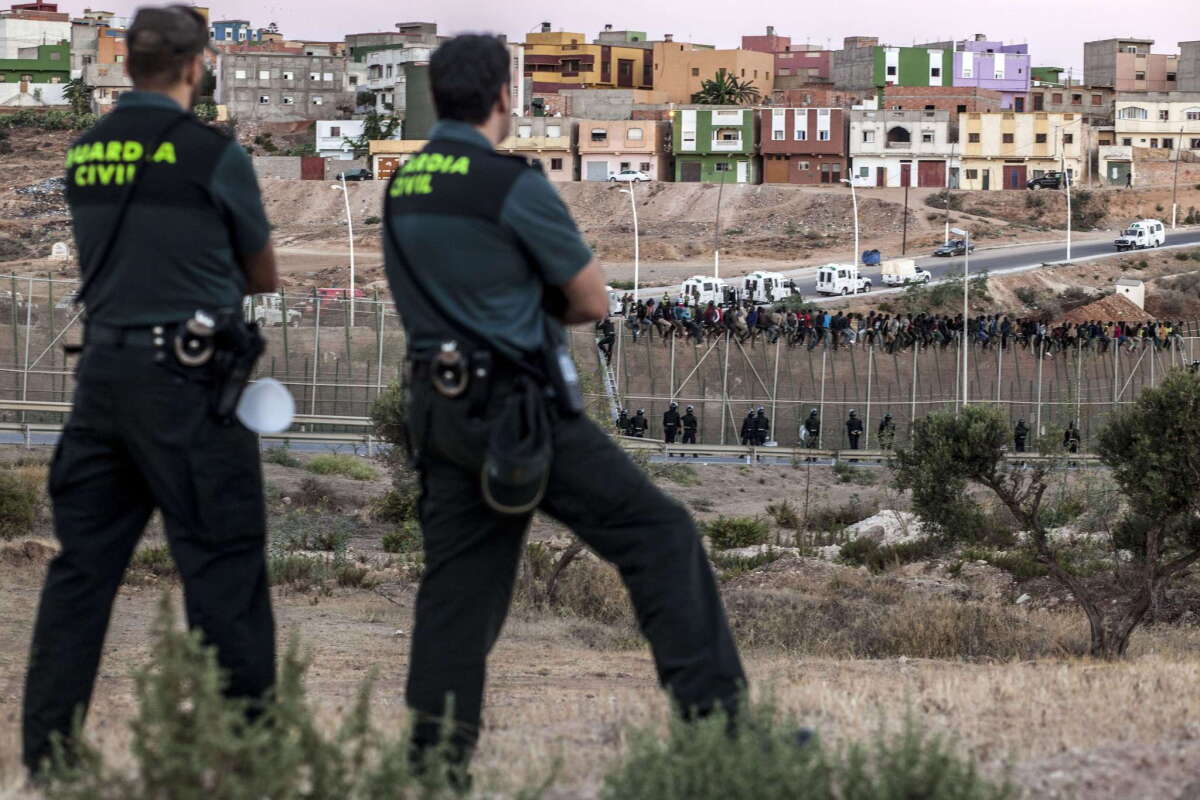
The scenes at Castell de Ferro also arrive against the backdrop of a far larger and more violent crisis playing out in Spain’s North African enclave of Ceuta, where tens of thousands of migrants stormed the border from Morocco in a matter of days, overwhelming police and leaving dozens dead. That crisis, unfolding just as the beach video went viral, has only sharpened public anger over the government’s ability to secure its own borders.
Ceuta has a long and troubled history with mass crossings. Spanish territory has weathered attempted breaches before, including a 2017 incident in which hundreds of migrants stormed a border fence and nearly five hundred made it across, and a 2021 crisis in which thousands swam and walked into the enclave in a single stretch of days. Each time, the pattern has been the same: overwhelmed police, viral footage, and political recriminations that fade until the next surge.